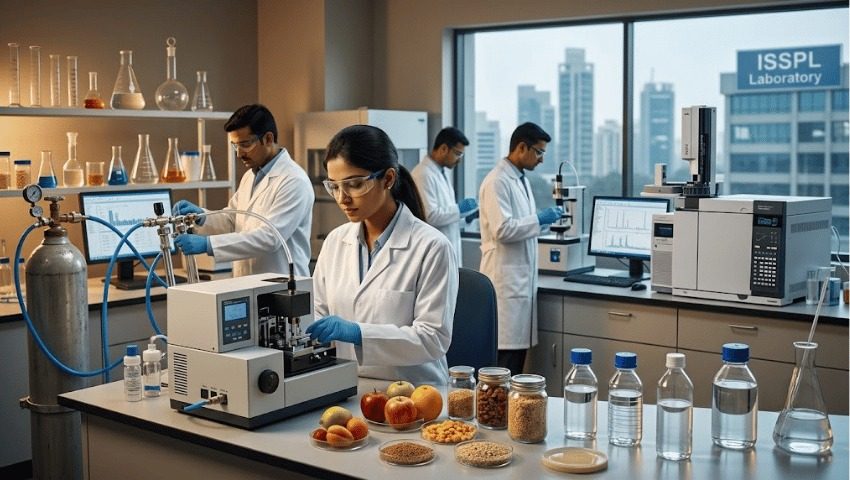
Organic Food Product Testing in India checks an organic product for pesticide residues, heavy metals, microbial contamination, aflatoxins and other quality parameters before it reaches the market. Organic certification confirms how a product was grown. Laboratory testing confirms what the finished sample actually contains. Both serve different purposes, and food brands, manufacturers and exporters often need both before launch or export.
The Word “Organic” on a Label Carries a Promise
A brand prints “organic” on a pack of spices. A customer pays a premium for it. Then a routine check finds pesticide residue in the same batch, and the promise on the label no longer holds. The product was sourced from a certified organic farm, yet the finished sample tells a different story.
This gap is where trouble begins. Organic certification and laboratory analysis answer two separate questions, and confusing them creates commercial and regulatory risk. This article explains what organic food testing covers, how it differs from certification, which parameters matter, and how to approach testing before a product launch or an export shipment.
Key takeaways:
- Certification verifies the production process. Testing verifies the finished sample.
- Pesticide residues, heavy metals and microbial contamination can appear even in certified organic food.
- Export markets set their own limits, so one report does not satisfy every destination.
- The correct test scope depends on the product, not on what another brand tests.
What Organic Food Product Testing Means
Organic food testing is the laboratory analysis of an organic product against defined safety and quality parameters. A laboratory receives a sample, applies validated methods, and reports what the sample actually contains.
The purpose is specific. Testing does not confirm organic status. It measures the presence and level of substances such as pesticide residues, heavy metals, microorganisms and toxins in the sample submitted.
This does not mean every organic product needs an identical panel. A pack of organic tea and a processed multi-ingredient snack carry different risks and different requirements. The appropriate scope follows the food matrix, the intended market, and any customer specification, rather than a fixed list applied everywhere.
Organic Certification Is Not the Same as Laboratory Testing
These two terms are often treated as interchangeable. They are not.
Organic certification confirms that a product was produced and handled according to recognised organic production standards. In India, organic foods may be certified under the National Programme for Organic Production (NPOP) or the Participatory Guarantee System for India (PGS-India). The FSSAI organic food framework is linked with these systems.
Laboratory testing examines the actual product sample for defined parameters. It reports measurable data on residues, contaminants and quality attributes present in that sample.
The key distinction is this. Certification addresses the process. Testing addresses the product. It would therefore be inaccurate to suggest that a certification mark on the pack removes the need to test the finished goods. A batch grown on a certified farm can still pick up contamination through soil, water, neighbouring fields, storage, transport or accidental mixing.
For a food business preparing for certification renewal, a product launch, a marketplace listing or an export shipment, both aspects can matter at different points.
Key Parameters in Organic Food Testing
Organic food testing is not one test. It is a set of parameters selected to match the product and its intended market. The parameters below cover the most common areas.
Pesticide Residue Testing
Organic farming restricts the use of conventional synthetic pesticides. Residues can still enter a product through contaminated soil, spray drift from adjacent farms, storage conditions or accidental mixing during handling.
Organic food pesticide residue testing is therefore one of the first checks to consider. It is particularly relevant for exporters. Under NPOP procedures, testing parameters for organic operations can include pesticide residues alongside other contaminants, and requirements may vary by destination country or region. Testing a batch beforehand gives you a clearer view before it reaches certification, customer or export scrutiny.
Heavy Metal Testing
Heavy metal contamination is not visible to the eye. Food and agricultural commodities can be exposed to metals through soil, water, environmental conditions or processing.
Heavy metal testing for organic food is often significant for brands dealing in rice, pulses, herbs, spices and processed products. A visual inspection tells you nothing about lead, cadmium, arsenic or mercury content. Only analysis does. ISSPL includes heavy metal analysis among its Food and Agriculture testing capabilities.
Microbiological Testing
Organic does not automatically mean microbiologically safe.
Food can be contaminated during harvesting, processing, storage, packing or transport. Poor hygiene and unsuitable storage conditions increase the risk. Microbiological testing assesses this quality before market release and helps identify potential food safety concerns. Detecting an issue in the laboratory is far less costly than discovering it after distribution.
Aflatoxin and Mycotoxin Testing
Grains, nuts, spices and oilseeds carry a particular risk here.
Aflatoxins are toxins associated with certain moulds, and they become a concern when agricultural commodities face unsuitable growing or storage conditions. Mycotoxin testing for organic food in India is therefore relevant for businesses dealing in these categories. ISSPL lists aflatoxin analysis among its Food and Agriculture testing services. The relevant parameters depend on the commodity and the applicable specification.
Nutritional and Physicochemical Parameters
Some testing supports the claims on your label rather than safety alone.
Nutritional analysis underpins the nutrition panel and any related labelling claim. Physicochemical parameters describe attributes such as moisture, acidity, ash content and other measurable properties that define product quality. These matter when a specification, a buyer or a labelling requirement calls for verified figures.
Stability and Shelf Life Parameters
Shelf life is a claim, and claims can be tested.
Stability studies assess how a product holds up over time under defined conditions. For a brand assigning a best before date or entering a new market, this data supports the shelf life stated on the pack rather than an assumption.
NPOP, FSSAI and the Indian Organic Regulatory Context
Understanding who governs what helps you plan testing sensibly.
The National Programme for Organic Production was launched in 2001 and is managed by APEDA under the Ministry of Commerce and Industry. According to APEDA, NPOP operates through accredited certification bodies and provides quality assurance for organic agriculture products in India. Exports from the country follow the provisions set out in NPOP.
The programme also carries international recognition. APEDA states that NPOP has equivalence with the organic food regulations of the European Union and Switzerland, and a recognition agreement on conformity assessment with the USDA. This equivalence relates to certification systems and does not remove the need to meet destination market limits on residues and contaminants.
On the domestic side, the FSSAI organic food framework links with NPOP and PGS-India, and the Jaivik Bharat logo identifies certified organic products in the Indian market.
Importantly, testing supports compliance decisions but does not by itself grant regulatory approval. Approval and compliance depend on the applicable regulation, the certification system, the destination market, and how the test data is used. A test report is analytical evidence, not a certificate of compliance.
Why Exporters Need Destination-Market Testing
Selling an organic food within India is one matter. Exporting it adds another layer.
Different importing markets set their own limits, testing expectations and residue requirements. APEDA export resources publish product and destination specific procedures, including information on maximum residue limits and agrochemicals for certain exports. A residue level acceptable in one market may exceed the limit in another.
The practical consequence is direct. You should not assume that compliance for one market makes the same shipment suitable for every other country. Organic food export testing in India, carried out against the relevant destination requirements before dispatch, helps you identify problems while the goods are still under your control rather than after they reach a foreign port.
When Organic Food Should Be Tested
Testing after a problem appears is the most expensive time to test. A risk based approach points to earlier, defined moments.
Consider testing in these situations:
- Before a product launch, so quality issues surface before stock reaches shelves.
- Before an export shipment, checked against the destination market requirements.
- During supplier or raw material qualification, before committing to a source.
- As part of routine quality control across production batches.
- After a contamination concern or an unexplained quality failure.
- Before making a specific label claim that a buyer or regulator may scrutinise.
Testing early gives you room to act while correction is still possible. Consider the alternative: a large batch is manufactured, packed, and sent to warehouses, and only then does a contamination issue emerge. At that stage the problem involves stock segregation, investigation, delayed dispatch and possible commercial loss. Laboratory testing works best as part of quality control, not as a response after the fact.
How to Select a NABL Accredited Food Testing Laboratory
Choosing a laboratory is a technical decision as much as a commercial one. A few markers help you compare providers fairly.
- Accreditation scope. NABL accreditation indicates that a laboratory has been assessed for technical competence for specific tests within its defined scope. Confirm that the parameters you need fall within that scope.
- Relevant recognitions. FSSAI and APEDA recognitions matter for food and export related testing. Check that the recognitions cover your product category and purpose.
- Method suitability. The laboratory should apply validated methods appropriate to your matrix and the required reporting limits.
- Parameter coverage. A single laboratory that can handle pesticide residues, heavy metals, microbiology and mycotoxins reduces the number of providers you coordinate.
- Sampling support. Correct sampling affects the reliability of results, so sampling capability is worth confirming.
Accreditation applies to defined tests, not to a laboratory as a whole. It would therefore be inaccurate to assume that a NABL accredited food testing laboratory is accredited for every test it offers. Always check the specific scope against your requirement.
How ISSPL Testing Lab Supports Organic Food Brands
ISSPL Testing Lab is operated by IRCLASS Systems and Solutions Pvt Ltd, an independent analytical testing service provider in India. Its Food and Agriculture testing services support manufacturers, brands, exporters and other food businesses.
The testing coverage is broad across food categories. ISSPL states that its capabilities extend to cereals and pulses, fruits and vegetables, herbs and spices, edible oils, tea, coffee, milk products, nuts, oilseeds, processed foods and honey, among others. Its Food and Agriculture portfolio includes pesticide residues, heavy metals, microbiological testing, aflatoxins, physicochemical parameters, nutritional labelling, residual solvents, stability studies and method validation.
For accreditation and recognition, ISSPL states that its laboratory holds approvals and recognitions from organisations including NABL, FSSAI, APEDA and EIC. This combination is relevant for organic food brands, because a single laboratory can address safety parameters, quality parameters and export related requirements within one testing relationship rather than across several providers.
ISSPL also states that it operates a pan India network of more than 40 sample collection centres, which helps businesses access its testing capabilities across the country. This does not mean every business needs the full range of services. The relevant point is that an organic food testing lab in India with this scope can match the test panel to your product and market rather than applying a fixed package.
Frequently Asked Questions
Does organic certification replace laboratory testing?
No. Certification confirms that a product was produced and handled according to organic production standards. Laboratory testing measures what the finished sample contains, such as pesticide residues, heavy metals or microbial contamination. The two serve different purposes, and many food businesses need both before launch or export.
Which parameters should organic food be tested for?
It depends on the product and market. Common parameters include pesticide residues, heavy metals, microbiological quality, aflatoxins, physicochemical attributes, nutritional values and stability. A packet of tea and a processed multi ingredient food will not share the same panel, so the scope should follow the specific product.
Does testing guarantee my organic product complies with regulations?
No. Testing produces analytical data on a sample. Regulatory compliance depends on the applicable regulation, the certification system, the destination market and how the data is used. A test report supports compliance decisions but does not by itself constitute approval.
Are Indian and export market testing requirements the same?
Not necessarily. NPOP holds equivalence with EU and Swiss organic regulations and a recognition agreement with the USDA, but destination markets can set their own residue and contaminant limits. Exporters should check the specific requirements of each market before finalising the test scope.
How much does organic food product testing cost?
Cost depends on the sample type, the number of parameters, the test methods and the reporting limits required. Because these factors vary by product and market, pricing is best confirmed against a defined scope rather than a single fixed rate.
How long does organic food testing take?
Turnaround depends on the parameters requested and the sample matrix, particularly where microbiological analysis requires incubation. Sharing your full parameter list and intended market at the enquiry stage allows the laboratory to advise a realistic timeline for your product.
Which businesses should consider organic food testing?
Organic food brands, manufacturers, processors and exporters are the most common candidates, particularly those preparing for a launch, a marketplace listing, certification or an export shipment. Businesses dealing in grains, spices, nuts and oilseeds often carry additional aflatoxin and contaminant considerations.
Test Before Your Organic Product Reaches the Market
An organic brand runs on trust, and that trust cannot rest on the word “organic” alone. The quality and safety of the actual product carry the same weight as the claim on the pack. Testing turns an assumption into verified data, and it does so while there is still time to act.
Businesses requiring Organic Food Product Testing in India can contact ISSPL Testing Lab to discuss their product category, intended market, applicable parameters and the right testing scope before launch or export. A short conversation about your product and destination market is usually the fastest way to define the correct panel before a quality issue becomes a commercial one.