Introduction
Selling products through online marketplaces has become an important business channel for thousands of Indian businesses. Platforms such as Amazon, Flipkart, Meesho and Myntra provide sellers access to a large customer base, but managing the financial transactions generated by these platforms requires careful accounting.
One of the biggest challenges sellers face is understanding the difference between their total sales, marketplace settlement amounts and actual bank credits.
Marketplace payments are not always equal to the gross value of orders. Various deductions, including commissions, shipping charges, fulfilment fees, refunds, returns and applicable taxes, can affect the final settlement.

Without a systematic reconciliation process, sellers may find it difficult to maintain accurate financial records, monitor marketplace deductions and prepare reliable GST-related accounting information.
This makes marketplace settlement reconciliation an important part of e-commerce financial management.
Why Marketplace Settlement Reconciliation Is Important
When a customer places an order, the seller records a sale. However, the marketplace may transfer the payment after deducting several charges and making adjustments.
As a result, the amount received in the seller’s bank account may differ from the original sales value.
For example, consider a seller who records ₹1,00,000 in marketplace sales during a reporting period.
The marketplace may make deductions for:
- Marketplace commission.
- Shipping and fulfilment charges.
- Marketplace service fees.
- GST on applicable marketplace services.
- Customer refunds and returns.
- Other settlement adjustments.
- Applicable tax deductions.
The remaining amount is transferred to the seller’s bank account according to the marketplace settlement cycle.

If the seller records only the net bank credit as sales, the accounting records may not accurately represent gross sales, expenses, taxes and adjustments.
A proper reconciliation process helps businesses understand how the original sales value was converted into the final settlement amount.
Common Settlement Reconciliation Challenges Faced by Sellers
1. Difference Between Sales and Bank Deposits
Marketplace sales reports and settlement reports serve different purposes.
Sales reports generally provide information about customer transactions, while settlement reports explain the payment calculations, deductions and adjustments.
Sellers need to compare these records to understand the final amount payable.
2. Marketplace Fees and Service Charges
Marketplaces may deduct commissions, fulfilment fees, shipping charges and other service-related costs.
These deductions need to be identified and recorded under appropriate accounting heads.
3. Returns, Refunds and Cancellations
Customer returns and refunds can affect sales figures and marketplace settlements.
Depending on the transaction and reporting period, adjustments may appear in a different settlement cycle from the original order.
This can make reconciliation more complicated when businesses rely only on monthly sales totals.
4. TCS and TDS Deductions
Indian e-commerce sellers may also need to account for applicable tax deductions.
Two important provisions include:
- GST TCS under Section 52: E-commerce operators collect tax at source on applicable net taxable supplies under the GST framework.
- Income-tax TDS under Section 194-O: Applicable e-commerce operator deductions need to be considered while reconciling seller payments and tax records.
These deductions should be appropriately identified and reconciled with the relevant tax records and statements.
5. Different Marketplace Reporting Formats
Amazon, Flipkart, Meesho and other marketplaces may provide financial information through different reports and formats.
Accountants may need to combine multiple files before preparing accounting entries.
Handling these differences manually can increase processing time and the possibility of data-entry errors.
Why GST Accounting Requires More Than Recording Sales
GST accounting for marketplace businesses involves more than recording the total value of customer orders.
Businesses need to consider the nature of transactions, applicable GST rates, tax invoices, credit notes, returns and marketplace-related deductions.
Some important areas include:
Sales and Taxable Value
The business needs to record sales and their applicable taxable values correctly.
Returns and Credit Notes
Sales returns and refunds may require appropriate accounting adjustments and credit note treatment, depending on the transaction.
GST on Marketplace Charges
Marketplace commissions, fulfilment services and other taxable services may include GST. Sellers need to account for these charges using the relevant invoices and applicable input tax credit rules.
TCS Reconciliation
GST TCS collected by an e-commerce operator needs to be reconciled with the relevant GST records.
TDS Reconciliation
Applicable income-tax TDS deductions should be checked against the relevant tax statements and accounting records.
A structured reconciliation process helps businesses maintain better visibility over these financial and tax-related components.
The Problem with Manual Excel-Based Reconciliation
Many marketplace sellers and accounting professionals use Excel spreadsheets, formulas and macros to reconcile marketplace reports.
While these methods can be useful, they may become difficult to maintain as the business expands.
Common issues include:
- Separate Excel files for each marketplace.
- Different report structures and column names.
- Repeated manual filtering and calculations.
- Difficulty tracking returns across settlement periods.
- Multiple versions of accounting macros.
- Additional time spent checking transaction-level differences.
Businesses handling multiple marketplaces or several seller accounts may benefit from a more organised report-processing and reconciliation workflow.
How Narti Solutions Helps Organise Marketplace Accounting
Narti Solutions focuses on simplifying marketplace report processing, data validation, reconciliation and accounting integration.
The platform is designed to help sellers and accounting professionals work with supported marketplace report configurations through a centralised application.
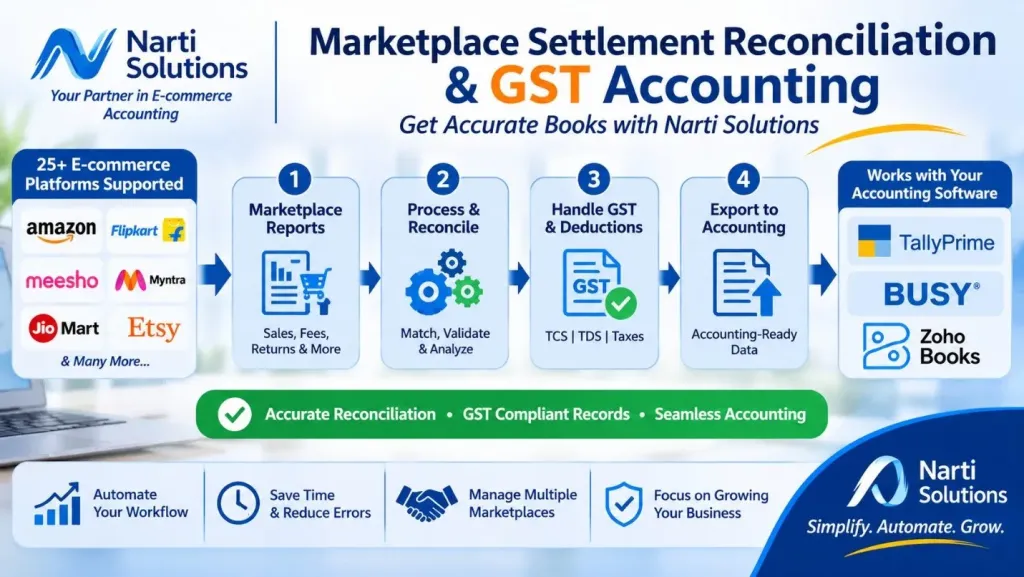
Its approach focuses on four important stages:
Step 1: Import Marketplace Reports
Users import the relevant marketplace reports containing sales, fees, returns, refunds and settlement information.
Step 2: Process and Validate Data
The system processes the available information and applies relevant validation checks.
AI-assisted data processing can support filtering and identification of potential inconsistencies, allowing users to review important information before preparing accounting entries.
Step 3: Prepare Accounting-Ready Information
Processed information can be organised into the required accounting structure, depending on the marketplace and supported workflow.
Step 4: Export to Accounting Software
Users can prepare data for supported accounting workflows, including TallyPrime, BUSY and Zoho Books.
This approach aims to reduce repetitive manual report preparation and make marketplace accounting more manageable.
It is important to note that reconciliation still requires appropriate review of source reports, invoices, settlement statements and bank records.
Who Needs Better Marketplace Settlement Reconciliation?
Marketplace Sellers
Sellers operating on multiple marketplaces need visibility into sales, deductions, returns and final payments.
Accountants and Bookkeepers
Professionals managing marketplace transactions can benefit from structured report processing and accounting preparation.
Chartered Accountant Firms
CA firms handling multiple e-commerce clients need organised financial information to support accounting, GST reconciliation and compliance-related work.
Growing E-commerce Businesses
Businesses increasing their order volumes may need to move beyond disconnected spreadsheets and develop more consistent accounting processes.
Moving Towards More Reliable E-commerce Accounting
Marketplace settlement reconciliation is not simply about matching a bank deposit with a sales figure. It involves understanding the complete transaction journey, including sales, deductions, returns, taxes and final settlements.
As Indian e-commerce businesses grow, accurate financial reporting and organised GST accounting become increasingly important.
By bringing marketplace report processing, validation and accounting integration into a unified workflow, Narti Solutions aims to help sellers and accounting professionals simplify these operations.
Businesses interested in improving their marketplace accounting processes can explore the available solutions at:
Website: https://nartisolutions.com/
Explore the platform and request a demo to understand the available marketplace configurations and accounting workflows.
About Narti Solutions
Narti Solutions develops software and automation solutions focused on e-commerce accounting, marketplace report processing, settlement reconciliation and accounting integration. Its solutions are intended for marketplace sellers, accountants, bookkeepers and CA firms working with supported e-commerce platforms and accounting applications, including TallyPrime, BUSY and Zoho Books.