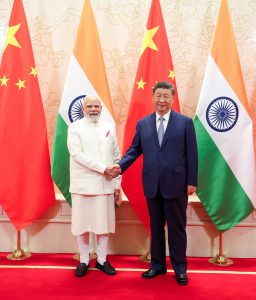
Bharat Mandapam, New Delhi, Wikimedia Commons, CC BY 4.0
The BRICS Summit in New Delhi concluded with leaders unanimously adopting the New Delhi Declaration on September 12.
The declaration called for restraint in the Middle East and addressed AI cooperation, energy security and local-currency trade, without directly condemning the US-Israeli strikes or Iran’s targeting of Gulf countries.
India mediated a joint statement between the UAE and Iran during the summit, with negotiations continuing until 4 am on September 12.
Prime Minister Modi described the outcome as reflecting a BRICS ‘wider in reach and stronger in purpose’, calling for time-bound action on the commitments made.
Security was tightened significantly at the Bharat Mandapam venue on the summit’s final day, with thousands of personnel deployed across Delhi.
BRICS did not launch a common currency at the summit, with the focus instead remaining on promoting local-currency trade and cross-border payment systems among member nations.
One of the summit’s notable diplomatic achievements was India’s mediating role in securing a joint statement between the United Arab Emirates and Iran, with talks reportedly continuing until 4 am on September 12.
PM Modi described the Declaration’s outcome as reflecting a BRICS that is ‘wider in reach and stronger in purpose’, urging members to translate the outcomes into time-bound action.
Security was tightened significantly at the Bharat Mandapam venue for the summit’s final day, with thousands of personnel deployed across New Delhi.
The 18th BRICS Summit brought together leaders and senior delegations from member states including Russia, China, South Africa, Iran and several newer bloc entrants.
Major summit themes included artificial intelligence cooperation, energy security, and stronger representation for Global South nations in international institutions.
The declaration’s adoption came after member states worked through sharp differences on the West Asia conflict and other contentious geopolitical issues in the lead-up to the summit.
The New Delhi Declaration called for restraint in the Middle East but stopped short of condemning either the US-Israeli strikes or Iran’s targeting of Gulf countries in the region.
Bharat Mandapam, New Delhi, Wikimedia Commons, CC BY 4.0