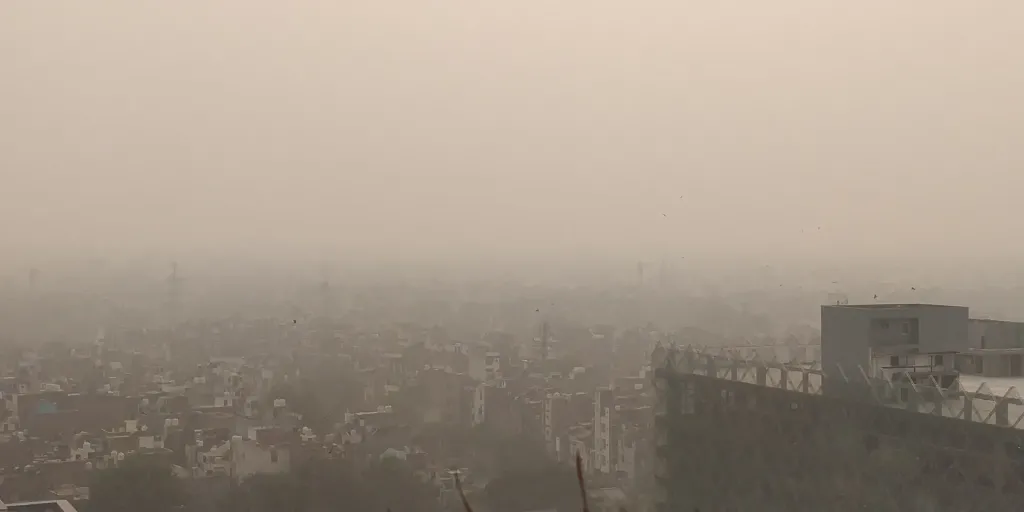
Delhi’s AQI reached 245 on October 21, the first poor reading of the season.
Falling night temperatures and light winds trap emissions, according to Skymet’s Mahesh Palawat.
Slow north-westerly winds carry farm fire smoke and festive emissions, according to Envirocatalyst’s Sunil Dahiya.
Stubble burning contributed an estimated 3.9% of PM2.5 on Wednesday.
GRAP Stage I has been invoked.
It was 227 at 7 am, 245 at 4 pm on the Central Pollution Control Board’s 24-hour average, and 248 by 8 pm, according to the same report.
Outlook India says the city had its most polluted day after Dussehra in five years, and the last higher post-festival reading was 284 in 2021.
Seven stations recorded very poor air, led by Pusa at 329 and Chandni Chowk at 326, according to Outlook India.
The Commission for Air Quality Management invoked Stage I of the Graded Response Action Plan, according to the reports.
Agencies across the National Capital Region are to implement, monitor and review the measures to prevent further deterioration, according to Outlook India.
Stage I applies when the AQI is between 201 and 300, and Stage II applies between 301 and 400, according to a report on the plan.
Stage I focuses on dust and waste, with road cleaning, water sprinkling, construction dust control and action against open waste burning, according to NewsDrum and Aryan Age.
Coal use in hotel and restaurant tandoors is restricted, and diesel generators are permitted only in emergencies, according to the reports.
Entry of intercity and interstate buses from several northern states is banned if they do not meet BS-VI norms and do not run on electricity or compressed natural gas, according to Outlook India.
Public transport has been expanded, including extra CNG and electric buses, and the Delhi Metro added 20 weekday trips from Thursday, according to the same report.
Air pollution in Delhi (file image), Wikimedia Commons, CC BY-SA 4.0