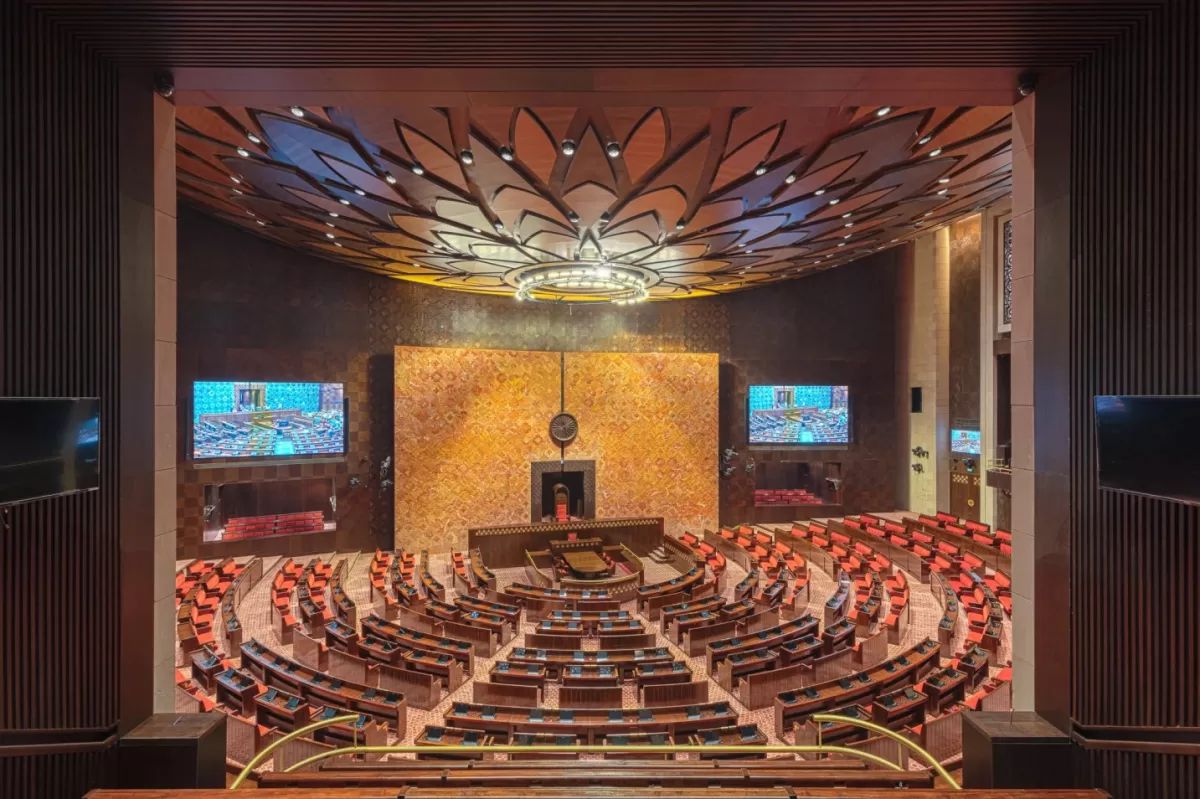
Rajya Sabha chamber, New Parliament building (representative image), Wikimedia Commons, GODL-India
Rajya Sabha members are elected indirectly by members of state legislative assemblies.
The election uses proportional representation through a single transferable vote.
The Election Commission notified elections for 27 seats across ten states on September 29.
One-third of Rajya Sabha members retire every two years.
The chamber has 245 members in total, including 12 nominated by the President.
The elections include a mix of biennial polls, for seats with terms ending on schedule, and bye-elections, for seats vacated before their term’s end.
Rajya Sabha members are elected indirectly by members of state legislative assemblies.
The election uses a system of proportional representation through a single transferable vote.
The Rajya Sabha, or Council of States, has 245 members in total, with 233 elected by states and union territories and 12 nominated by the President.
One-third of Rajya Sabha members retire every two years, with elections held to fill the resulting vacancies.
The 2026 Rajya Sabha election cycle overall covers 72 seats across the year, from March through November.
Political parties typically begin candidate selection processes soon after an Election Commission notification is issued.
State assembly numbers determine the vote share each party commands in electing its state’s Rajya Sabha members.
Rajya Sabha elections do not involve direct voting by the general public, unlike Lok Sabha elections.
The Rajya Sabha plays a co-equal role with the Lok Sabha in most legislative matters, except money bills.
Election schedules, including nomination, scrutiny and polling dates, are announced by the Election Commission following the notification.
The Rajya Sabha is a permanent body that is never fully dissolved, unlike the Lok Sabha.
Each state’s number of Rajya Sabha seats is roughly proportional to its population, as fixed under the Fourth Schedule of the Constitution.
Independent candidates can also contest Rajya Sabha elections, though party-backed candidates dominate most contests.
Rajya Sabha chamber, New Parliament building (representative image), Wikimedia Commons, GODL-India