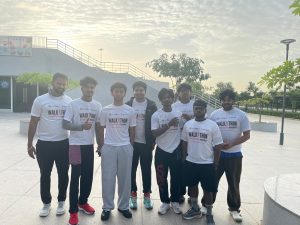
Guest lecturer, competition finalist, serial pitcher, horseman — and, above all, a founder obsessed with getting the details right. A closer look at the person behind Focus Realm, and the through-line connecting everything he does.
To understand Focus Realm, you first have to understand the person who built it, because the company is less a business plan than a personality rendered in software.
Sehej Sharma, the company’s co-founder and CEO, is not easy to reduce to a single sentence. He is the founder who will spend twenty minutes arguing that a feature should be removed. He is also, in his other life, a horseman who has competed in showjumping and dressage and spends weekends on a polo field — a sport that punishes exactly the thing he prizes most in software: the illusion that you can control the outcome without mastering the fundamentals.
“People think polo is about aggression,” he says. “It is almost entirely about preparation and position. If your fundamentals are wrong, no amount of effort in the moment saves you. I think that is true of hotels, and true of companies. You do not fix a bad shift by shouting on the day. You fix it by building the right system beforehand.”
That instinct — that quality is decided long before the visible moment — is the thread running through everything Sharma has done, and it is the foundation of Focus Realm.
A founder before he founded
Sharma’s path to Focus Realm was not a straight line, and he is candid that the detours are where he learned the most. Long before this company, he was pitching ideas, including an earlier venture he took into competitive settings, learning in real time how to hold a room, answer a hard question, and take a rejection without losing the thread of his conviction.
He also found himself, unusually early, on the other side of the table — as a teacher and a mentor. He has guest lectured at IIT Delhi, spoken to cohorts at business schools, addressed young founders at an Ideathon, and presented at incubation and innovation events, coaching students on how to think about problems before rushing to solutions.
“I learned more about my own thinking by having to explain it to a room of sharp students than almost anywhere else,” he says. “When a nineteen-year-old asks you ‘but why does that matter?’ and you do not have a clean answer, you realise your idea is not as finished as you thought. Teaching keeps you honest.”
He credits competitive environments — including reaching the sharp end of a CEO challenge — with teaching him a lesson he now applies to product decisions daily: that clarity beats cleverness, and that the person who can explain something simply usually understands it best.
“When a sharp nineteen-year-old asks ‘but why does that matter?’ and you do not have a clean answer, you learn your idea is not as finished as you thought.”
The conviction that came from home
If the discipline came from the arena and the pitch room, the mission itself came from somewhere far more personal: his own dinner table.
Sharma’s mother has worked in hospitality for years, and he grew up hearing the same frustration on repeat — not about guests, but about the gap between the standard a hotel had written down and what actually happened on a busy shift. Training that did not stick. Compliance tracked on paper, if at all. A standard that lived in a binder no one opened.
“I was hearing this company’s problem statement across the dinner table years before I had any language for it,” he says. “I understood, viscerally, that the people doing the most important work in a hotel were the least supported by the tools around them. That never left me.”
When he and his co-founders, COO Ali Electricwala and CTO Aditya Mishra, eventually built Focus Realm, that memory became the test every decision had to pass. “When we argue about whether a feature belongs, I picture my mother at the end of a long shift, looking at the screen,” Sharma says. “Would this help her, or is it one more thing to deal with? If it is one more thing, it goes.”
What he actually built
Focus Realm builds software that gets the standard out of the binder and into the moment of work. Its hospitality product, Focus Realm Hospitality, runs a tight loop: the SOP lives inside a timed task, completing the task generates photo and supervisor evidence, and that evidence becomes an audit-ready service record. The company is explicit that this is not a learning management system — it is about whether the standard happened on the shift, not whether an employee watched a video.
The tagline compresses the whole ambition into three words: Every shift, five-star.
“People read that as aspirational,” Sharma says. “To me it is a test, and the word that matters is ‘every.’ Any hotel can deliver a five-star shift when the owner is visiting. The mission is the ordinary Tuesday night, when nobody senior is watching. That is where reputations are actually made, and lost.”
The philosophy: build less, on purpose
The single most defining thing about Sharma as a founder is what he refuses to do. Where most founders chase more features, he has built his company on the opposite instinct. Industry estimates suggest up to 80 percent of features in typical platforms go unused, and Sharma treats that figure as a personal design brief.
He calls the discipline strategic minimalism. “Anyone can add a feature,” he says. “It takes real conviction to tell a paying customer ‘we will not build that,’ because the feature would clutter the one screen a busy staff member actually has to use. That restraint is not laziness. It is respect for the person at the end of the chain.”
“Any hotel can deliver a five-star shift when the owner is visiting. The mission is the ordinary Tuesday night, when nobody senior is watching.”
The same person, everywhere you look
Ask people who have watched Sharma across his different arenas and a consistent portrait emerges: a person who is calm under questioning, generous with credit, allergic to hype, and relentless about fundamentals. He speaks about his co-founders with unusual warmth, crediting Electricwala with keeping the company from ever overpromising a client and Mishra with a subtraction-first design philosophy that keeps the product honest.
It is the same character whether he is steadying a horse before a jump, fielding a hostile question at a pitch, explaining a first principle to a room of students, or deleting a feature from a product spec. In every case, the belief is identical: do the unglamorous preparation, respect the fundamentals, and the visible moment takes care of itself.
The road ahead
Focus Realm is pre-revenue and working openly toward its first paying hotel customer before the end of 2026, with early relationships in motion with properties including Clarks Hotels & Resorts and The Hosteller. Sharma’s longer vision is for the company to become the operating system for service standards in hospitality — and, through a second product line serving universities and colleges, to carry the same discipline into education.
But he is in no hurry to dress up the present. “I would rather be a founder people watched actually build something, mistakes and all, than one who only appears once the story has been polished for a press release,” he says.
Then, the line that could serve as a summary of the man himself: “If Focus Realm succeeds, it will not be because we did more than everyone else. It will be because we had the discipline to do less, and do it so well that it was the only thing anyone needed.”
About Focus Realm
Focus Realm builds software that gets standards out of the binder and into the shift. Its hospitality product, Focus Realm Hospitality, turns hotel SOPs into timed tasks that generate photo and supervisor evidence and an audit-ready service record. The company also serves universities, colleges and schools with bespoke digital learning ecosystems. It is led by Sehej Sharma (Co-Founder & CEO), Ali Electricwala (Co-Founder & COO) and Aditya Mishra (CTO). Tagline: Every shift, five-star.
Connect
Website: focusrealm.org
Sehej Sharma on LinkedIn: linkedin.com/in/sehej-sharma-5b2151234
Focus Realm on LinkedIn: Focus Realm company page