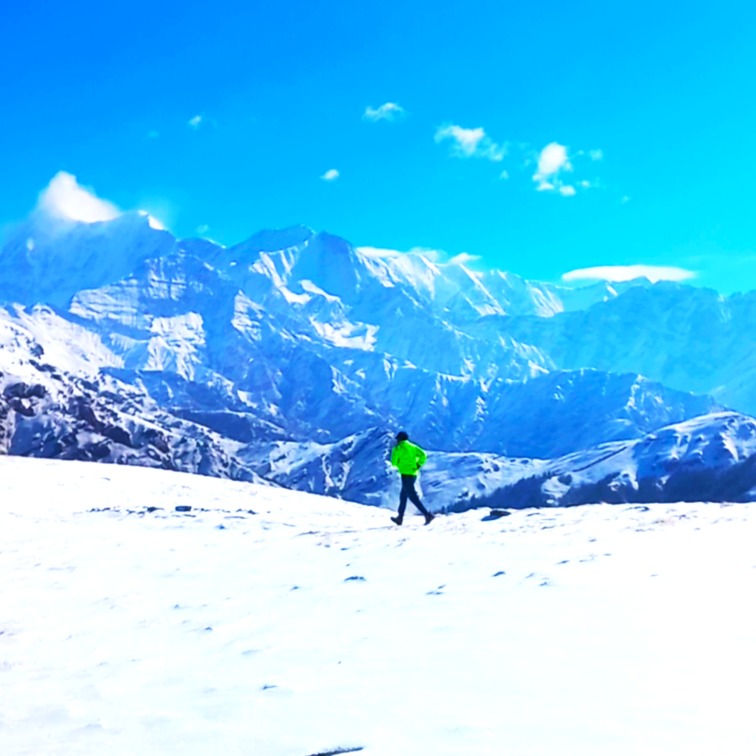
By Anil Mohan
Over the years, I have watched people arrive at race start lines for very different reasons.
Some are chasing a personal best. Some want to become fitter. Some are running their first 5K. Others have already completed several marathons. There are runners who have followed a training plan for months and others who are simply hoping to finish.

Despite those differences, everyone standing at a start line has made the same basic choice: they have decided to do something that requires effort.
That is what makes running interesting.
It is not something most people have to do. Nobody is required to wake up before sunrise to run, spend months preparing for a marathon or travel to a difficult trail simply to test themselves.
Yet people choose to do it.
Perhaps part of the answer lies in something fundamental about human nature: we are curious about what we are capable of.
It Usually Starts With a Small Goal
Most runners do not begin with the ambition of completing a marathon.
The first goal may be much simpler — running a kilometre without stopping, completing a 5K, becoming more active or improving fitness.

Then, gradually, the goal changes.
A 5K becomes a 10K. Ten kilometres becomes a half marathon. For some, the next step is 42.195 kilometres.
The interesting part is not simply that the distance becomes longer.
The runner’s understanding of what is possible changes as well.
Someone who once believed that running was not for them may eventually discover that they can train consistently, deal with discomfort and complete a distance that once seemed unrealistic.
That is one of the quiet lessons of endurance sport: we often discover our limits only after we begin testing them.
Running Is Also a Conversation With Yourself
A race may have hundreds or thousands of participants, but every runner experiences it differently.
There are difficult kilometres when the body becomes tired and the mind starts looking for reasons to slow down. There are training sessions that go badly and races where the expected result does not happen.
These experiences can teach more than a good performance.
Running requires patience. It requires discipline and the willingness to repeat something difficult even when progress is slow.
It also teaches acceptance.
Not every training session will be good. Not every race will produce a personal best. Sometimes the sensible decision is to slow down, change the target or try again another day.
Over time, those lessons can extend well beyond running.
The Clock Records the Result, Not What It Took to Get There
Running is easy to measure.
There is distance, pace, time and position.
But a race result tells only part of the story.
The clock records how long a runner took. It does not record what it took to get there.
For an experienced marathoner, finishing in four hours may be a familiar achievement. For someone completing their first marathon, the same distance may represent months of preparation, uncertainty and determination.
That is why endurance cannot be understood only through numbers.
There is another measure that is harder to record: the distance between who we were when we started and who we became along the way.
Why Do People Choose Difficult Things?
The question extends beyond running.
People cycle hundreds of kilometres when a vehicle could cover the same distance much faster. They walk long trails when roads are available. They climb mountains when easier destinations are within reach.
The attraction is not necessarily difficulty for its own sake.
It is often the opportunity to experience something outside the familiar.
A challenging experience can reveal how we respond when conditions change, plans fail or continuing becomes uncomfortable.
It can teach patience.
It can expose weaknesses.
It can reveal strengths that are difficult to see during an ordinary routine.
In that sense, exploration is not only about discovering new places.
It can also be a way of discovering ourselves.
From Road to Trail to Mountain
For some runners, the road is only the beginning.
Road races provide a structured introduction to endurance. Over time, some runners become curious about trails, where uneven terrain, climbs and descents become part of the challenge.
From there, the mountains offer another level of complexity.
Altitude, weather, terrain and isolation can become as important as distance. At extreme altitude, familiar ideas such as pace and performance can change considerably.
The progression can be described simply:
Road → Trail → Mountain → High Altitude
But it is not a path that every runner needs to follow.
It is better understood as a range of possibilities within the wider world of endurance.
Uttarakhand Has a Natural Connection With Endurance
This is one reason Uttarakhand has an interesting opportunity.
The state offers an extraordinary variety of terrain, from urban roads and valley routes to forests, trails, mountain paths and high-altitude passes.
Dehradun occupies an important position within this geography.
It provides the infrastructure of a city while remaining closely connected to the Himalayan landscape. That gives it the potential to become a meeting point between conventional road running and the wider world of outdoor endurance.
A runner can begin with a road race in Dehradun and, if they choose, eventually discover a very different experience on the trails and mountains of Uttarakhand.
The Sarmang Journey
This is also how the Sarmang journey has gradually taken shape.
The Sarmang Dehradun Marathon, scheduled for 4 October 2026, brings runners together through multiple road-race distances. The introduction of a 51K Ultra extends the event beyond the traditional marathon distance and reflects the growing interest in longer endurance challenges.
But an event should not be judged only by the distance printed on its race bib.
A first-time participant may discover running through a short-distance race and eventually become a marathoner. A marathoner may discover trail running. A trail runner may become interested in mountain or high-altitude challenges.
The race can be a destination, but it can also be a beginning.
Testing Limits Does Not Mean Ignoring Them
There is an important difference between testing our limits and ignoring them.
This distinction becomes particularly important when endurance moves into challenging mountain environments.
The body has limits. So do weather, terrain and altitude.
Understanding endurance means learning when to continue and when to adjust.
Sometimes strength is demonstrated by pushing through a difficult section.
Sometimes it means slowing down.
And sometimes the correct decision is to turn back and return another day.
The objective of a mountain challenge should not be to defeat the mountain.
The mountain does not need to be defeated.
The objective is to move through the environment safely, intelligently and respectfully.
That is a more sustainable understanding of endurance.
No Difficult Effort Is Completely Individual
Running often appears to be an individual pursuit because every person has their own pace, training plan and finish time.
In reality, a runner’s effort usually involves many other people.
Families make time for training. Friends become training partners. Coaches provide guidance. Volunteers stand along courses for hours. Medical teams prepare for emergencies. Fellow runners offer encouragement when someone is struggling.
On race day, these individual contributions come together.
That is why a marathon can become more than a sporting competition. It can become a shared experience for an entire community.
The finish time belongs to the runner.
The experience belongs to everyone who helped make it possible.
A Different Way of Measuring Success
Not every runner is chasing the same goal.
One person may be competing for the podium. Another may be trying to qualify for another race. Someone else may simply want to complete their first 10K.
There is no single definition of success.
For one runner, success may mean a personal best.
For another, it may mean finishing despite difficult circumstances.
For someone else, it may simply mean showing up and taking the first step.
Perhaps the more useful question is not:
“Did I beat someone else?”
but:
“Did I become capable of doing something I once thought I couldn’t?”
That is a different way of looking at endurance.
What Comes After the Finish Line?
A finish line marks the end of a race, but it does not necessarily mark the end of a runner’s interest in challenge.
The next goal may be another distance, a different terrain or simply a new personal target.
For some, that might mean progressing from a 5K to a marathon.
For others, it could mean moving from the road to a trail, and eventually towards the mountains.
There is no requirement to keep going farther.
The important thing is the willingness to remain curious about what is possible.
Beyond Running
The value of endurance is not that everyone should run longer distances.
It is that challenging experiences can teach us something about ourselves.
Running can teach discipline.
Trails can teach adaptability.
Mountains can teach respect.
Long efforts can teach patience.
And stepping outside a familiar routine can reveal strengths that might otherwise remain hidden.
This is why endurance matters.
Not because difficulty is valuable for its own sake, but because stepping beyond the familiar creates opportunities for discovery.
For one person, the challenge may be five kilometres.
For another, it may be a marathon.
For someone else, it may lead to a Himalayan trail or a high-altitude challenge.
The distances are different. The terrain is different. The reasons are different.
But the underlying instinct can be the same:
to explore, to endure and to discover what lies beyond the limits we have placed on ourselves.
Perhaps that is one of the simplest answers to why we run.
We run because the experience gives us a chance to discover not only how far we can go, but who we can become along the way.
About the Author
Anil Mohan is the Founder of Sarmang Adventure Tours and Secretary of Sarmang Society. He is involved in organising running, endurance, adventure and high-altitude events in the Himalayan region.